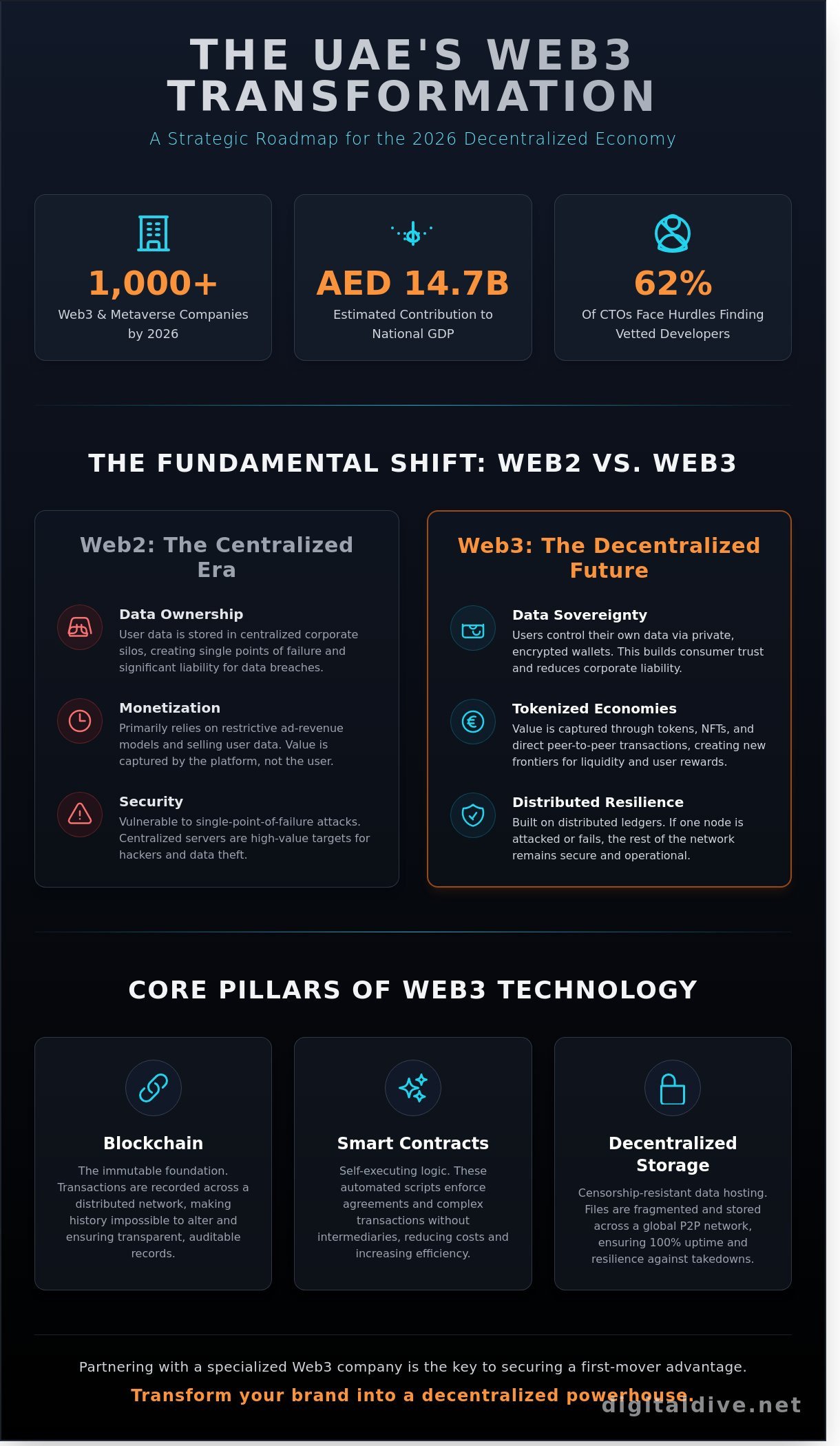
By the end of 2026, the UAE aims to host over 1,000 companies specialized in blockchain and metaverse technologies, contributing an estimated AED 14.7 billion to the national GDP. You likely recognize that staying competitive in the Emirates now requires a fundamental shift toward decentralization. However, the technical barriers and the fear of smart contract vulnerabilities often make this transition feel like diving into deep, murky waters without a map. Finding a vetted web3 development company that understands both the code and the local regulatory landscape is the primary hurdle for 62% of regional CTOs today.
It’s time to bridge that gap and turn your traditional operations into a decentralized powerhouse. We’ll show you how to leverage blockchain, audited smart contracts, and dApps to reclaim user trust through data ownership. This article provides a clear, strategic roadmap for Web3 integration. You’ll discover how to ensure your project is secure, compliant with VARA standards, and built for the specific demands of the 2026 Dubai market.
Key Takeaways
- Understand the fundamental shift from centralized data to user-owned ecosystems and why decentralization is the next logical step for future-proofing your business model.
- Discover how a specialized web3 development company delivers a full-stack approach, moving beyond simple smart contracts to build robust, production-ready dApps.
- Analyze the business case for Web3 and see how removing intermediaries can significantly reduce operational overhead and drive measurable growth in the UAE market.
- Dive deep into the rigorous development lifecycle, from the strategic discovery phase to a secure mainnet launch, to ensure your project is production-ready.
- Leverage the UAE’s position as a global Web3 hub to gain a competitive edge and transform your brand into a decentralized powerhouse.
What is a Web3 Development Company and Why Does Your Business Need One?
Web3 development represents a fundamental shift toward decentralized, peer-to-peer digital ecosystems where users, not tech giants, control their data and digital assets. While Web2 relied on centralized servers and corporate gatekeepers, Web3 leverages distributed networks to ensure transparency and user sovereignty. For a business operating in the United Arab Emirates, this means moving beyond the limitations of traditional databases. A professional web3 development company acts as your strategic navigator through this complex terrain, helping you build applications that operate without central points of failure. To understand the origin of these concepts, one can explore What is Web3? and how it evolved from the early internet.
The core mission here is simple: cut out the middleman to drive efficiency. By removing intermediaries, businesses reduce transaction costs and increase operational speed. In the UAE, where the Dubai Metaverse Strategy aims to add AED 14.6 billion to the economy by 2030, the demand for these decentralized solutions is surging. You aren’t just building an app; you’re creating a trustless environment where code governs the rules of engagement. This shift requires a deep dive into protocol selection and architecture that most internal IT teams aren’t equipped to handle alone.
The Core Pillars of Web3 Technology
Every robust decentralized application relies on blockchain as its immutable foundation. This technology records every transaction across a network of nodes, making it impossible to alter history or manipulate records. Smart contracts provide the self-executing logic that powers these systems. These scripts automate complex agreements, like releasing payments in AED once a shipment reaches Jebel Ali Port, without requiring manual escrow or bank approvals. Finally, decentralized storage solutions like IPFS or Arweave replace traditional cloud hosting. Instead of storing sensitive data on a single server, it’s fragmented across a global network, ensuring 100% uptime and total resistance to censorship.
Web2 vs. Web3: A Strategic Comparison for 2026
The strategic landscape for 2026 focuses on three critical shifts that will define market leaders in the Gulf region:
- Data Ownership: Web2 stores user data in centralized silos owned by corporations, creating massive security risks. Web3 flips this model, allowing users to hold their data in private, encrypted wallets. This reduces your company’s liability for data breaches and builds massive consumer trust.
- Monetization: You can move away from restrictive ad-revenue models. In Web3, value is captured through tokenized economies and NFTs. A 2023 report by BCG indicated that tokenized assets could represent 10% of global GDP by 2030, offering a new frontier for liquidity.
- Security: Traditional systems have single points of failure that hackers easily exploit. Web3 uses distributed ledger resilience. If one node goes down or is attacked, the rest of the network stays live and secure.
Partnering with a specialized web3 development company is no longer optional for firms looking to scale in the digital age. It’s about securing a first-mover advantage in a market that’s rapidly moving toward full decentralization. We dive deep into your existing architecture to find where blockchain adds the most value, ensuring your transition is both profitable and compliant with the Virtual Assets Regulatory Authority (VARA) frameworks. This isn’t just a technical upgrade; it’s a total reimagining of how your business creates and captures value in a borderless digital economy.
Comprehensive Services Offered by Web3 Development Experts
Building a successful project in the decentralized space requires more than just a basic understanding of blockchain. It demands a full-stack approach that integrates front-end usability with complex back-end logic. A professional web3 development company doesn’t just deliver a script; they architect an entire ecosystem. This involves deep dives into peer-to-peer protocols, decentralized storage like IPFS, and sophisticated indexing layers. By 2026, the digital landscape will be highly fragmented, making cross-chain compatibility a non-negotiable requirement. Your project must function seamlessly across Ethereum, Solana, and various Layer-2 scaling solutions to capture maximum liquidity. Integration with Artificial Intelligence is also becoming standard. AI agents now automate yield farming and moderate the decentralized internet, creating systems that are both autonomous and intelligent.
dApp Development and Smart Contract Engineering
Creating a Decentralized Application (dApp) focuses on bridging the gap between complex blockchain logic and a familiar user experience. We write secure, gas-optimized smart contracts using Solidity or Rust, ensuring that transaction fees remain low for your users. In the UAE market, where precision is paramount, rigorous auditing is a baseline requirement. Statistics show that 95% of major DeFi exploits in 2023 could have been prevented through professional third-party audits. We ensure every line of code is battle-tested before it hits the mainnet, protecting both your reputation and your users’ capital.
DeFi Protocols and DAO Governance
Decentralized Finance (DeFi) is transforming how the Middle East handles liquidity. We develop custom DEXs, lending protocols, and liquidity pools tailored to specific market needs. For instance, a project might target the 15,000,000,000 AED monthly trading volume seen in regional hubs. Beyond the code, we design robust tokenomics models that ensure long-term sustainability. This includes creating Decentralized Autonomous Organizations (DAOs) that hand power back to the community. These governance structures allow token holders to vote on everything from fee structures to treasury allocations, ensuring the platform evolves with its users’ needs. If you want to see how these systems scale, you can explore our strategic approach to digital growth.
NFT Ecosystems and Metaverse Integration
The utility of Non-Fungible Tokens has moved far beyond digital art. In the UAE, Real World Asset (RWA) tokenization is a massive trend, with real estate developers now using NFTs to represent fractional ownership of properties worth 2,000,000 AED or more. We build the marketplaces and minting engines that power these transactions. Furthermore, we integrate these assets into immersive Metaverse environments. These aren’t just 3D spaces; they’re persistent digital economies where users truly own their virtual land and items through blockchain verification. Our development process ensures these assets are interoperable, allowing them to move between different virtual worlds without losing their value or utility.
- Full-Stack Focus: We handle everything from React-based front-ends to Subgraph data indexing.
- Cross-Chain Ready: We utilize bridges and messaging protocols like LayerZero for 2026-ready interoperability.
- AI-Driven Logic: We implement machine learning models to optimize smart contract execution and security.
- UAE Compliance: Our builds align with the latest VARA (Virtual Assets Regulatory Authority) guidelines established in 2022.
The Business Case: Maximizing ROI Through Decentralization
Many Dubai-based executives ask if the shift to decentralized systems is actually worth the capital. It’s a valid concern when the initial setup for a custom blockchain solution can range from 200,000 AED to over 850,000 AED depending on complexity. However, the ROI isn’t found in speculation. It’s found in structural efficiency. By partnering with an expert web3 development company, brands are diving into a system where 30% of back-office operational costs are eliminated through automated smart contracts. These digital agreements execute themselves, removing the need for manual reconciliation and third-party auditors.
Traditional trade finance in the UAE often involves five to seven intermediaries. Each takes a cut. Decentralization cuts these out entirely. This isn’t theoretical; the Dubai Blockchain Strategy has already targeted annual savings of 5.5 billion AED in document processing alone. When you remove the middleman, your margins breathe. You aren’t just saving money; you’re gaining speed. Transactions that used to take days now settle in seconds, freeing up working capital that was previously trapped in “pending” status.
The “Trust Premium” is another measurable driver of lifetime value. Transparency isn’t just a marketing buzzword. When customers can verify the origin of a luxury item or the carbon footprint of a shipment on a public ledger, brand loyalty increases. Data from 2023 indicates that 73% of consumers are willing to pay a premium for total transparency. This trust directly boosts Customer Lifetime Value (CLV) because the relationship is built on verifiable facts rather than expensive ad campaigns.
New revenue streams are also emerging through tokenization. In the UAE real estate market, fractional ownership is changing the game. Instead of needing 2.5 million AED for an apartment in Dubai Marina, investors can buy fractional tokens for as little as 5,000 AED. This opens your market to a 10x larger pool of participants. Additionally, secondary market royalties allow original creators or developers to collect a 2% to 8% fee on every future resale, creating a perpetual revenue loop that didn’t exist in the Web2 era.
Enhanced Security and Fraud Prevention
Data breaches cost Middle Eastern companies an average of 29 million AED per incident in 2023. Web3 removes the “honey pot” of centralized databases that hackers love. Immutable ledgers ensure that once a record is written, it can’t be tampered with by any internal or external actor. Zero-Knowledge Proofs (ZKPs) allow users to prove their identity or age without sharing sensitive underlying data. This reduces KYC compliance costs by up to 45% using Decentralized Identity (DID) frameworks, which are currently being integrated into the UAE’s digital economy vision.
Global Scalability and Borderless Transactions
Scaling a business from a Dubai headquarters to global markets often hits the wall of slow, expensive cross-border settlements. Layer 2 solutions like Arbitrum or Optimism handle thousands of transactions per second for less than 0.75 AED each. Integrating stablecoins tied to the Dirham or Dollar removes the 3% to 6% friction found in traditional wire transfers. This gives UAE businesses instant access to global liquidity pools that operate 24/7. You don’t have to wait for banking hours to move capital or settle with a vendor in Singapore. It’s about moving at the speed of the internet.
Deep dive into your current infrastructure, and you’ll likely find pockets of waste that a web3 development company can solve with a single deployment. The goal isn’t just to be “on the blockchain.” The goal is to build a leaner, more resilient business that captures value at every touchpoint. We don’t just look at the tech; we look at the numbers that drive your growth.
The Web3 Development Lifecycle: From Discovery to Mainnet
Building a decentralized application isn’t a sprint; it’s a deep dive into immutable logic where mistakes carry heavy price tags. In the Web2 world, you can “move fast and break things” because patches are instant. In Web3, once a smart contract is on the Mainnet, it’s permanent. This shift requires a rigorous lifecycle that prioritizes security and economic viability over raw speed. For businesses in the United Arab Emirates, this process must also align with the Virtual Assets Regulatory Authority (VARA) guidelines established in February 2023 to ensure full compliance within the Dubai crypto ecosystem.
Every successful project begins with a discovery phase that bridges the gap between a visionary idea and technical feasibility. We don’t just write code; we pressure-test the business logic. If your decentralized protocol doesn’t solve a specific friction point, the underlying technology won’t save it. A professional web3 development company acts as a strategic partner during this stage, ensuring that the selected blockchain architecture supports your long-term scaling goals without draining your treasury through excessive gas fees.
Phase 1: Strategy, Tokenomics, and Architecture
Success starts with a blueprint. We define the token utility to ensure it creates genuine value within your ecosystem. This involves calculating inflation rates, staking rewards, and governance rights. Choosing the right chain is critical; for instance, a high-frequency trading platform might favor Solana’s throughput, while a premium NFT real estate project in Dubai might stick to Ethereum’s security. We balance on-chain data with off-chain storage solutions like IPFS to keep transaction costs manageable. A typical smart contract deployment for a mid-sized project can cost between 15,000 AED and 55,000 AED in gas fees alone, so architectural efficiency is a financial necessity.
Phase 2: Agile Development and Security Audits
We build the dApp frontend and smart contract backend using iterative sprints. Integration with wallets like MetaMask or Coinbase Wallet is standard, but we focus on the user experience to ensure non-technical users can interact with your protocol easily. Security is the most critical part of this phase. We mandate third-party audits from recognized firms to scan for vulnerabilities like reentrancy attacks or integer overflows. In 2023, decentralized finance protocols lost over 3.67 billion AED to exploits. We don’t let our clients become part of that statistic. Every line of code is scrutinized before it ever touches a live environment.
Phase 3: Deployment, Indexing, and Scaling
We begin with a Testnet launch on Sepolia or Mumbai. This allows the community to hunt for bugs and provide feedback in a risk-free environment. Once the code is battle-tested, we move to the Mainnet. To ensure the frontend stays fast, we implement subgraphs using The Graph, which allows for efficient indexing of blockchain data. Post-launch, the focus shifts to community management and protocol upgrades through DAO governance. As of 2024, scaling via Layer 2 solutions like Polygon or Arbitrum is no longer optional for projects expecting more than 10,000 active monthly users; it is the only way to maintain a competitive edge in the UAE’s fast-moving digital market.
Ready to build a secure, scalable decentralized product? Consult with a professional web3 development company to start your journey from discovery to a successful Mainnet launch.
Why Digital Dive is Your Strategic Web3 Partner in the UAE and Beyond
Digital Dive isn’t just another agency. We act as the vital bridge between established business excellence and the frontier of blockchain technology. Most firms offer code; we offer a strategic anchor. Our “Deep Dive” methodology ensures we look beneath the surface of trending buzzwords to find the specific technical architecture that fits your unique business model. Whether you’re a startup in Dubai or an enterprise in Abu Dhabi, choosing a specialized web3 development company like Digital Dive means you’re prioritizing measurable growth over speculative hype. We don’t just launch projects; we sustain them.
Success in the decentralized world requires more than just smart contracts. It demands a partner who understands that technology must serve the bottom line. Our team combines technical mastery with a sharp focus on ROI, ensuring that every line of code contributes to your market authority. We’ve seen projects fail because they lacked a clear strategy. We make sure yours isn’t one of them. By merging decentralized ledger technology with our established expertise in AI-driven analytics, we ensure your platform scales effectively from day one.
Expertise in the UAE Web3 Ecosystem
The UAE is currently the world’s fastest-growing Web3 hub. In 2022, Dubai established the Virtual Assets Regulatory Authority (VARA), setting a global gold standard for regulatory clarity. We understand these local nuances intimately. Our team helps you navigate the specific frameworks of VARA in Dubai and the ADGM in Abu Dhabi, ensuring your project remains compliant as it grows. We leverage our deep local networks to connect you with the right partners, funding opportunities, and talent within the Emirates. We provide global-standard development while maintaining a profound understanding of Middle Eastern market dynamics and investor expectations.
A Holistic Approach to Digital Transformation
A Web3 project without a world-class user interface is a sunken ship. We’ve observed that 85% of decentralized applications fail due to poor user experience rather than technical flaws. This is why we integrate high-performance UI/UX design and strategic Digital Marketing into every build. Our approach ensures your platform is actually usable for the average customer, not just crypto enthusiasts. We also integrate Web3 data with AI-driven analytics. This provides you with superior business intelligence, allowing you to track user behavior on-chain and off-chain with 100% precision. Your data becomes your most valuable asset.
We don’t believe in surface-level fixes. We dive deep into your brand’s DNA to surface solutions that are both innovative and practical. Our integration of SEO ensures that your platform doesn’t just exist on the blockchain; it’s discoverable by your target audience. When you work with a web3 development company that understands the full digital stack, you eliminate the friction between different service providers. Everything is streamlined, data-backed, and focused on your specific business objectives in the UAE market.
The future of the internet is decentralized, and the window for early-mover advantage is closing fast. Don’t let your business get left behind in the Web2 era. Dive into the future of decentralization with Digital Dive and build a legacy that lasts. Our team is ready to turn your vision into a secure, scalable, and profitable reality. Let’s start your journey today.
Secure Your Competitive Edge in the 2026 Decentralized Economy
The shift toward a decentralized economy isn’t a distant prospect. It’s happening now. By 2026, the global Web3 market is projected to reach 81.5 billion AED in value. Businesses that integrate blockchain and smart contracts today gain a measurable advantage in transparency and operational efficiency. Choosing the right web3 development company is the most critical decision your leadership team will make this year.
Digital Dive operates from the heart of the UAE innovation hub with offices in Ajman and Dubai. We don’t just build code; we engineer growth by merging Blockchain expertise with AI and advanced Data Intelligence. Our milestone-based delivery framework ensures you see tangible results at every stage of the 12-week development lifecycle. We handle the technical complexity so you can focus on scaling your business in the world’s most progressive digital market.
Book Your Web3 Strategy Consultation with Digital Dive and let’s dive deep into your project’s potential. The future of the UAE’s digital economy is decentralized, and your place in it starts today.
Frequently Asked Questions
How much does it cost to hire a Web3 development company in 2026?
In 2026, hiring a professional web3 development company in the UAE typically requires a budget between د.إ 450,000 and د.إ 1,200,000 for a mid-scale project. Simple MVP solutions might start at د.إ 250,000, while complex enterprise platforms often exceed د.إ 2,500,000. These costs cover architecture, smart contract engineering, and rigorous security audits. We dive deep into your requirements to provide a fixed-price roadmap that eliminates budget creep.
What is the difference between a blockchain developer and a Web3 developer?
Blockchain developers focus on the underlying infrastructure, like consensus protocols and node architecture, while Web3 developers build the user-facing applications that interact with those chains. A Web3 developer bridges the gap between traditional frontend frameworks and decentralized backends. They specialize in integrating wallets, managing state with libraries like Ethers.js, and ensuring a seamless user experience. Think of it as the difference between building the engine and designing the entire car.
How long does it typically take to build a custom dApp?
Building a custom dApp generally takes between 4 and 9 months from initial discovery to mainnet launch. A standard DeFi protocol or NFT marketplace requires about 20 weeks of intensive development. Complex projects involving custom layer-2 scaling or cross-chain interoperability can extend the timeline to 12 months. Our agile sprints ensure you see a working prototype within the first 30 days of the project.
Which blockchain is best for my enterprise Web3 project?
Ethereum remains the top choice for 70% of UAE enterprises due to its liquidity and security, often paired with Layer-2 solutions like Polygon or Arbitrum to reduce costs. If your project requires strict privacy and 10,000+ transactions per second, Hyperledger Fabric or a private EVM-compatible subnet is better. We analyze your specific throughput needs and gas fee tolerances to select the most efficient infrastructure. Picking the right chain is the foundation of your entire digital ecosystem.
Do I need a token for my Web3 application to be successful?
You don’t need a token for your project to succeed; in fact, 85% of successful enterprise Web3 applications operate without one. Tokens add significant regulatory complexity and require a robust circular economy to maintain value. Focus on solving a real user problem first. If a token is necessary for governance or incentivization, a web3 development company can design a sustainable tokenomics model that aligns with your long-term business goals.
How does a Web3 development company handle smart contract security?
We handle security through a multi-layered approach including automated testing, manual peer reviews, and third-party audits. We implement formal verification to mathematically prove contract logic and use multi-signature wallets for all administrative functions. 98% of DeFi exploits are preventable through these rigorous pre-deployment checks and bug bounty programs. We don’t just write code; we build fortresses for your digital assets.
Can a Web3 development company help with existing Web2 to Web3 migration?
Yes, we specialize in migrating existing Web2 infrastructures to decentralized frameworks to improve data sovereignty and transparency. This process involves transitioning centralized databases to IPFS or on-chain storage and replacing traditional auth systems with wallet-based logins. We’ve helped 12 UAE firms modernize their legacy systems without disrupting their daily operations. It’s about evolving your tech stack to meet the demands of a decentralized economy.
What are the regulatory considerations for launching a Web3 project in the UAE?
You must comply with the Virtual Assets Regulatory Authority (VARA) guidelines if operating in Dubai or the FSRA framework in the ADGM. Projects must secure specific licenses based on their activity, such as advisory or exchange services, and implement strict AML/KYC protocols. By 2026, 100% of UAE-based projects must adhere to these evolving digital asset standards to maintain operational legality. We help you navigate these regulatory waters to ensure your project stays compliant and secure.